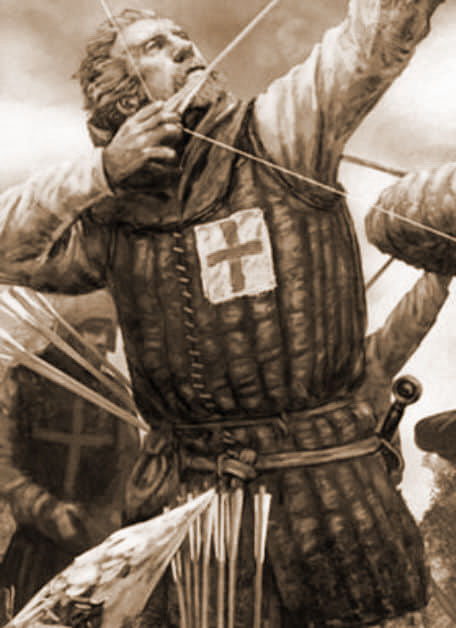
In what capacity could the Coterels have served at Halidon Hill? …A writer’s conundrum
Every historian knows the feeling: you come across a detail you could quite reasonably ignore, yet it becomes a conundrum that refuses to leave you in peace.
One of mine was a deceptively simple question — in what capacity did James Coterel and his followers serve at Halidon Hill in 1333?
The Rotuli Scotiae records that they received a pardon for their service after the battle. That alone could have been enough — they fought, they were forgiven. The capacity in which they served, however, is not recorded, and the question didn’t sit neatly with the usual assumptions about social status and military roles.
What follows are a few considerations that guided my approach:
First, the Derbyshire commissions for the campaign called for archers and hobelars — the standard mechanism for raising infantry at county level. Men-at-arms served through a separate system, contracted via noble retinues. For outlaws seeking rehabilitation, the commission offered the most direct route back into royal favour, meaning they had to serve in whatever category the Crown demanded.
Second, the structure of the pardon itself is the most revealing detail. A man-at-arms would not typically appear in a pardon document alongside his own servant as a co-recipient — a servant has no independent military standing, and his inclusion tells you something precise about the nature of the service. The pardon treats James and his followers as a single unit, but it is a unit that includes a servant and several lower-status followers ineligible for men-at-arms service. This composition does not align with a men-at-arms retinue but aligns naturally with a body of archers.
Third, his later role in mustering a hundred archers for William Deyncourt shows that he was already regarded as someone who knew the county, understood the demands of archery service, and could be relied upon to produce competent men.
Fourth, their criminal record offers a small but telling clue. The Coterels used bows in their criminal activities — behaviour that was highly unusual. A study of eight counties in the same period found that only around 5% of recorded felonies involved a bow. Their familiarity with the weapon was therefore distinctive, not incidental.
None of this diminishes what James Coterel went on to become. Once restored to the king’s peace he almost certainly served as a man-at-arms — the background was there, and the trajectory of his later career points in that direction. But in 1333, as an outlaw seeking rehabilitation, he served on the Crown’s terms, not his own.
Taken together, the balance of probability points towards James Coterel leading a group of archers at Halidon Hill. It only takes a sentence to state the conclusion — but the path to it is where the real work lies.
Sometimes the harder challenge for a historian isn’t the lack of evidence, it’s the pull of a question that didn’t necessarily require an answer.