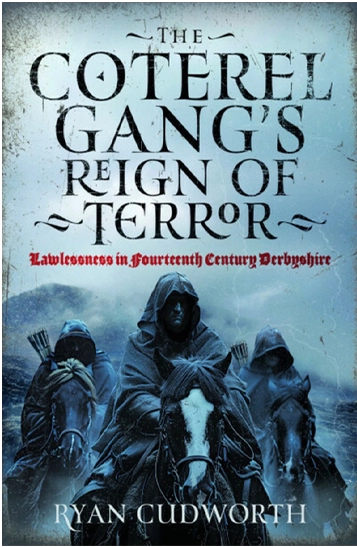
My work on the Coterel gang began a few years ago, when I came across an article discussing real medieval outlaws who may have shaped the Robin Hood tradition. I wasn’t searching for the “real” Robin Hood, but the Coterels caught my attention immediately. Their territory lay in the High Peak of Derbyshire, a landscape I know well, and their story unfolded in the turbulent fourteenth century, a period already rich with conflict, famine, and political upheaval.
Researching the gang meant working with medieval records that present their own challenges. Most surviving documents come from the legal system: structured, formulaic, and frustratingly silent on motive. They record the felony, not the story behind it. Reconstructing events required weighing evidence, tracing patterns, and accepting that some conclusions must remain provisional.
Over the years I visited many of the places that appear in the narrative, and I’m grateful to the churchwardens who let me explore buildings whose stones still remember the Coterels’ world. Effigies of several figures connected to the story survive, and seeing them in person helped bridge the gap between archive and landscape.
Writing this book also meant grappling with the wider medieval world: feudal obligations, currency systems, military service, social hierarchy, and the machinery of medieval justice. None of these can be ignored if we want to understand how a family like the Coterels could rise, operate, and traverse their world.
What I hope emerges from this work is a narrative that reveals a remarkable family navigating a century defined by crisis. At its centre stands James Coterel—a man with striking leadership skills, able to build alliances across social boundaries while never abandoning the raw instinct for self‑preservation. Their story unfolds against a backdrop of political chaos, wars with Scotland and France, devastating famine, and the desolation left by the plague.