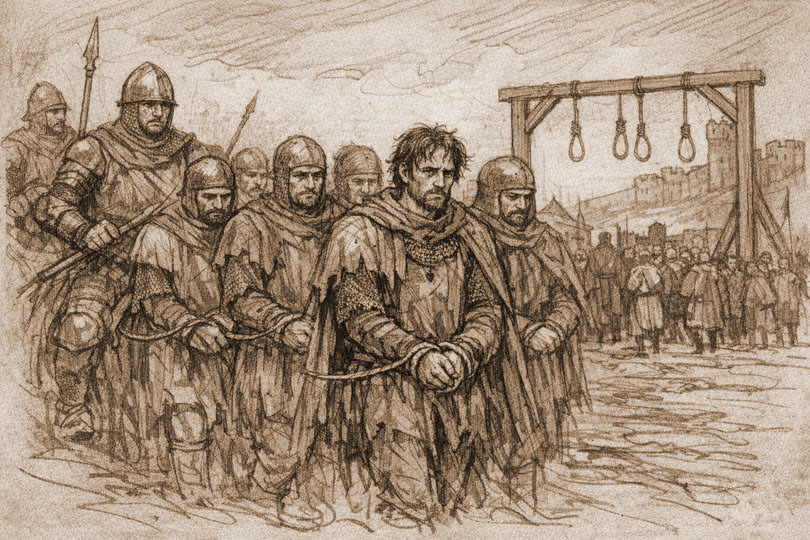
Shortly before the execution of Thomas, Earl of Lancaster, on this day in 1322, Henry Bradbourne was hanged alongside several of his fellow rebels at Pontefract. A loyal retainer of Lancaster, Bradbourne paid the ultimate price in the aftermath of the failed baronial uprising and the crushing defeat at the Battle of Boroughbridge.
Chronicler Henry Knighton wrote that these men were hanged to “increase the torment” of Lancaster. Bradbourne and his companions “hung for a long time upon the gallows for greater disgrace […] nor did the king and the Despensers allow them to be taken down or buried.” A calculated display of royal vengeance.
Bradbourne’s brothers, William and John, fared better. They were likely among the Boroughbridge deserters—supporters of Lancaster, but not retainers bound by personal service or obligation.
Soon after, they fell in with the notorious Coterel brothers of Derbyshire, joining the inner circle of the outlaw band that styled itself the society of the “Wild Men.”
Led by James Coterel—dubbed the King of the Peak—the group carved out a fearsome reputation in the criminal underworld of early 14th‑century England.
The Bradbournes’ story is a reminder of how rebellion fractures not only kingdoms but families. One brother died for loyalty, others lived by abandoning it, and all were shaped by the brutal politics of a turbulent age.