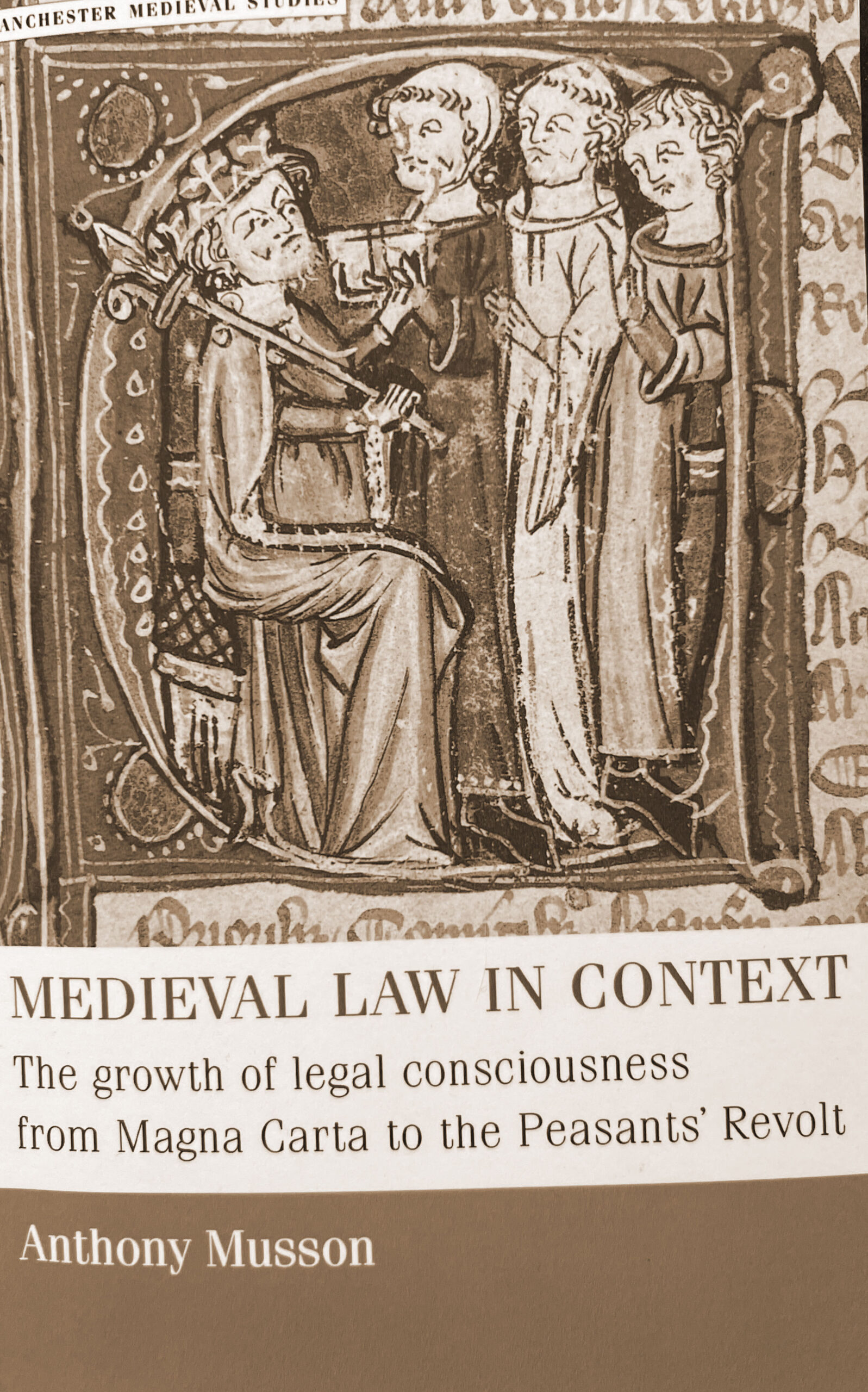
In fourteenth‑century England, legal consciousness simply meant knowing how the law worked in practice — which courts mattered, what procedures could be used, and how to turn legal rules to your advantage. Anthony Musson shows this kind of everyday legal awareness was widespread. People learned it by attending courts, serving in local offices, hearing announcements in church, and dealing with documents like charters or writs. You didn’t need formal training, you just needed experience.
Ralph Coterel himself had strong reasons to develop legal knowledge. As steward of Bakewell, he oversaw manorial courts, handled disputes, and enforced local custom. As a landholder, he needed to understand feudal rights such as wardship and marriage — powerful legal instruments for shaping family status and influence. But the Coterels were not unique. Many people in the fourteenth century used legal consciousness to defend themselves, delay proceedings, or exploit gaps in the system.
Having a legal consciousness could allow you to:
- Challenge a court’s authority
- Use procedure to buy time or avoid conviction
- Present your actions in a way that sounded lawful
- Navigate the space between local and royal power
The Coterel affinity: legal consciousness in action
- Robert Lovet (Ashwell) sheltered the Coterels in his church at Ashwell. When Northampton’s peace commissioners tried to prosecute him for receiving them, he simply pointed out that Ashwell lay in Rutland, not Northamptonshire. Because the commission’s authority was strictly territorial, the Northampton case collapsed. Lovet didn’t need legal representation, he just needed to know where jurisdiction stopped.
- Robert de Veer obeyed his summons to appear on charges of maintaining and receiving the Coterels. He knew the case couldn’t proceed because the principals — the Coterels themselves — were not to be found, and their case had to be decided first. He also knew he would be held in gaol, but crucially, he understood he could apply for bail. His compliance wasn’t submission, it was a calculated move based on procedural knowledge.
- William Uston faced multiple felony accusations. He produced a royal pardon and refused to answer the charges. The pardon didn’t cover murder, but Uston argued that he couldn’t be charged as an accessory because the principal in the alleged murder had already been acquitted. In medieval law, you couldn’t instigate a crime that legally no longer existed. Uston used a technical point to shut down a serious accusation.
- The Coterels after Boroughbridge (1322) After the rebellion collapsed, the Coterels robbed fleeing rebels and hid the loot across Derbyshire. When royal officials demanded forfeiture, they handed over only a token amount and claimed they had acted to hinder the Lancastrian cause. This positioned them as loyalists rather than opportunistic thieves. Later, when faced with the robbery charges, they argued immunity under the king’s proclamation that no man would suffer for actions taken to obstruct Lancaster. They used royal policy, and its ambiguities, to protect themselves.
These examples show how the Coterels operated within a world where knowing the law was just as valuable as breaking it!